
Bernardus Djonoputro elaborates on how the public-private partnership can foster sustainable urbanization in the Global South and worldwide
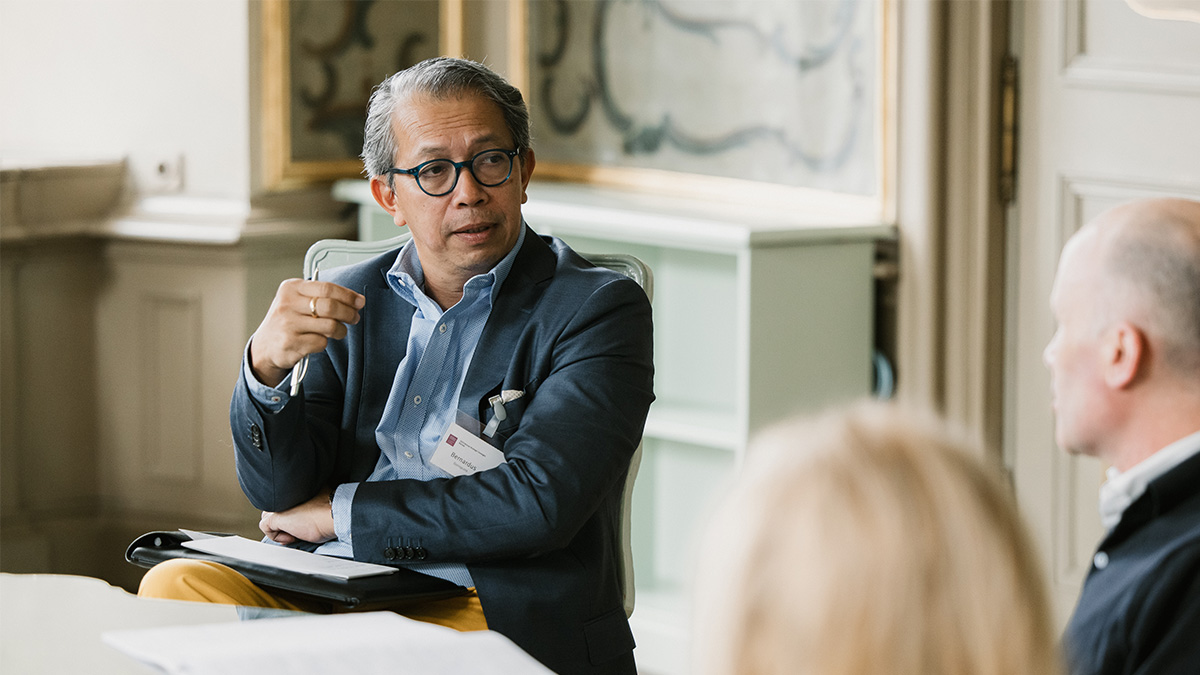 Photo Credit: Katrin Kerschbaumer
Bernardus Djonoputro is CEO of the Rebana Metropolitan Management Authority in the West Java province of Indonesia and a long-time Salzburg Global Fellow. He focuses on the public-private partnership, as his career spans finance, infrastructure development, and city planning.
This interview has been edited for length and clarity.
Audrey Plimpton, Salzburg Global Communications Associate: How do you think the private sector can contribute to the public sector and vice versa?
Bernardus Djonoputro, CEO of the Rebana Metropolitan Management Authority: The government today has a complex task of planning, developing, and building the right infrastructure to keep up with urbanization… especially in the Global South where we see rural areas transforming into urban [areas] and the rapid development of urban society. By the end of this century, 85% of people in the world will be living in urban areas… in the next few years [until 2030], 5 billion people will be living in cities. How to manage the organization of this is a challenge for every government in the world. We face the challenge of not only coming up with the right policies and infrastructure but also how to finance all of it. This is where the private sector and governments need to look at the whole equation. We've seen public finance initiatives in the world… but we also see countries that weren't very successful in getting private participation and the provision of needed infrastructure in cities.
AP: What are some challenges facing the Asia-Pacific region?
BD: I think it is important to look at the future as an issue for the new regions of the Asia-Pacific, where a lot of what we're talking about today is happening. I'm referring to the challenge of coping with urbanization and taking advantage of productive urbanization which is happening in the Global South. This transformation requires a lot of resources and working together. I think the cumulative knowledge and network that Salzburg Global has today will be important to shape what the dialogue will be in that part of the world.
AP: How do you think the discussions from this program can inform your current and future work?
BD: We have talked a lot about collaboration and innovative thinking in government, which is very important. We touched upon thinking beyond the role of government to take a more aggressive look at the future. I think this is very useful for anyone in the government or the private sector. It's important for us to see the trends and have tools to make the right projection… especially given new technological advancements like artificial intelligence, which in turn requires us to figure out how to use these as tools for better planning.
AP: What do you hope to gain from your exchanges with public sector leaders during the program?
BD: During the [program], I talk about big questions, which are: how do we look at the future of city regions that are interdependent with each other? How do we manage the flow of labor, finance, [and] resources between city agglomerations around the world? How does a metropolitan [area], as an economy and region of itself, connect with peers around the world? This is food for thought for everybody participating in the forum, [and] to look at what will be the most collaborative way of working together… I hope that this [Public Sector Strategy] Network will be alive and that we can work together on our individual tasks in a collaborative way and contribute to the success of each other.
Bernardus recently attended the 2023 Annual Strategic Foresight Retreat, which enables senior public sector leaders to speak openly among peers about major disruptive forces confronting governments. We spoke to him during this program on May 22-24, 2023.
The 2023 Annual Strategic Foresight Retreat is part of the Public Sector Strategy Network. This program is supported by the Abu Dhabi Office of Strategic Affairs, in cooperation with apolitical.