
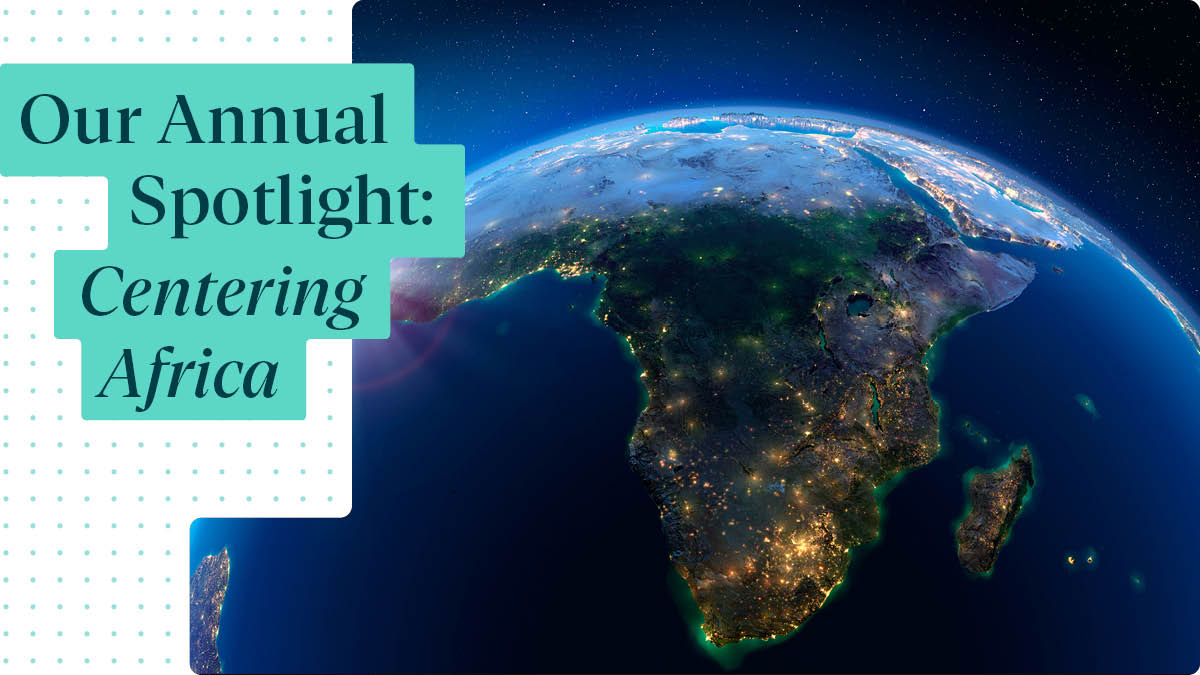
Across our sessions and events in 2025, Salzburg Global is highlighting the central role that the African continent will play in shaping the 21st century
In 2025, a quarter of the way through the 21st century, Salzburg Global’s programs, sessions, and events will include a special focus on the African continent and its potential to have a revolutionary influence on the rest of this century.
As demographic trends across much of the world project a future of older and less productive economies, the African continent stands out for its growing youth population, its dynamism and innovation, and its increasingly central role in addressing numerous global challenges, including economic transformation and poverty alleviation, youth opportunity and employment, technology and cultural innovation, and climate change and conservation.
As we plan our 2025 sessions and special events, Salzburg Global will therefore seek to highlight the central role that the African continent—in all its diversity, complexity, and promise—will play in shaping the 21st century.
In addition, we are seeking to increase the number of African Fellows in our programs and to increase the number of interns from the continent. We are also hoping to engage our partners, Fellows, and friends across the African continent to actively participate in our “Centering Africa” Spotlight throughout 2025.
This year’s annual spotlight will include a series of Africa-focused Salzburg Global sessions and special events. Through these spotlight sessions and events, it is our hope that Salzburg Global can play a small but meaningful role in highlighting and promoting African ideas, innovations, and perspectives from across the continent and to “center Africa” in global forums like ours.
Throughout the year, we will continue to update this page with information about these sessions and events. To stay up to date with our special “Centering Africa” Annual Spotlight, please sign up for our monthly newsletter and follow us on LinkedIn, Facebook, Instagram, Threads, YouTube, Flickr, and X.
We welcome your feedback and participation. Please get in touch by emailing info@salzburgglobal.org.
We officially launched our “Centering Africa” Spotlight on November 21, 2024, with a Salzburg Global Salon in Washington, DC. The evening’s discussion featured diverse views from across the African continent, highlighting the opportunities and ideas that “center Africa” in a new vision for 21st-century global development.
On December 3, 2024, we hosted a luncheon event at the 2024 International Democracy Union Forum in Washington, DC. Under the theme “Seizing Africa's Infrastructure Potential: Long on Promises, Short on Action?”, the event featured an intimate, moderated discussion between Patrick Oboi Amuriat, Party President of Uganda’s Forum for Democratic Change, and Salzburg Global President and CEO, Martin Weiss.
In the context of this year's Salzburg Cutler Fellow Program, we hosted an online panel discussion ahead of the in-person session.
This focused on Africa's place in the international legal order and the ways in which international law can best contribute to sustainable development and human rights on the continent. The session centered around the voices of leading scholars and practitioners of international law from or working on the African continent. Speakers included:
In March, Salzburg Global staff traveled with members of Salzburg Global's Board of Directors to South Africa, Rwanda, Ghana, and Kenya. The purpose of these visits was to ensure we are not only bringing our “Centering Africa” Spotlight to Salzburg Global in 2025 but also bringing Salzburg Global to Africa.
As part of this trip, Salzburg Global’s Board of Directors met in Nairobi, Kenya, where the African Wildlife Foundation hosted our Board Meeting.
These trips helped strengthen ties with Fellows, forge new connections, and gain fresh insight into the diverse challenges and opportunities shaping the continent today.
In Ghana, the pace was set early with a dynamic gathering of government, finance, and industry leaders. The following weekend offered a rich immersion into the country's political, economic, and cultural life.
From standing at Cape Coast and Elmina Castle, reflecting on the nation's historical legacy, to exploring Ghana's thriving creative and entrepreneurial scenes, the visit brought home the energy and promise of a country in motion.
In Rwanda, the focus centered on reconciliation and renewal—three decades after the genocide. Conversations with Fellows at the Kigali Genocide Memorial and visits with environmental innovators and conservation partners illuminated how healing, memory, and sustainability are being woven into Rwanda's path forward.
A surprise encounter between Rwandan and Ukrainian Fellows—each engaged in reconciliation efforts in their home countries—was a poignant reminder of Salzburg Global's unique global network and the power of shared purpose.
In South Africa, the themes of justice and legacy came to the fore. Meetings in Cape Town and Johannesburg with Fellows, thought leaders, and civil society actors underscored the enduring importance of reflection and reform.
Highlights included a moving visit to Nelson Mandela's homestead, discussions with the Nelson Mandela Foundation, and conversations with leaders in the financial sector—offering a textured view of the nation's history and its evolving present.
The journey concluded in Kenya, where Salzburg Global convened its Board Meeting at the African Wildlife Foundation headquarters in Nairobi. The setting provided an inspiring backdrop for robust discussions about institutional growth, regional partnerships, and Salzburg Global's long-term vision.
The week ended with a memorable Fellows gathering at the Karen Blixen Coffee Garden, celebrating connection and collaboration across continents.
Together, these experiences reaffirmed Salzburg Global's commitment to listening, learning, and engaging deeply with the communities and Fellows shaping the future—across Africa and around the world.
In April, we hosted our third annual Pathways to Peace Initiative session, “Africa Forum: Centering an African Vision for a New Multilateral Future.”
This session highlighted African perspectives and ideas in ways that elevate the key role and distinct contributions of the African continent in an emerging geopolitical nexus of cooperation and competition, including pathways that might lead to a more peaceful, prosperous, and sustainable 21st century.
In 2025, we will devote our annual Salzburg Global Weekend to the “Centering Africa” Spotlight.
Our annual Salzburg Global Weekend is a special program for our Board of Directors, Fellows, and invited guests and will feature a diverse group of speakers and Salzburg Global Fellows to discuss the profound influence that the African continent—in all its diversity, complexity, and promise—will have in shaping the 21st century.
As the grand finale to our Salzburg Global Weekend, we will host an all-day open house at Schloss Leopoldskron.
The Salzburg Global Open House will include a series of talks, readings, films, concerts, and cuisine that showcase our annual spotlight to our community of Fellows, partners, friends, and staff.
Building on Salzburg Global’s longstanding work in international higher education, and in collaboration with the Payne Research Center at the Thurgood Marshall College Fund, this program will focus on advancing transatlantic collaboration among Historically Black Colleges and Universities (HBCUs) in the United States, Historically Disadvantaged Institutions (HDIs) in South Africa, and other colleges and universities in similar contexts.
In recognition of the importance of international exchange in addressing the complex challenges confronting under-resourced colleges and universities, this session will specifically seek to foster new connections and collaborations among HBCUs in the US, HDIs in South Africa, and similar under-resourced institutions around the world, many of which share a legacy of structural inequities, systemic discrimination, and underfunding in infrastructure, research, and academic outcomes.
On the anniversary of Salzburg Global’s first session in 1947, we are encouraging our Fellows to host their own Fellow-led events across Africa, in Salzburg and elsewhere around the world to highlight our annual spotlight. If you would be willing to organize a Salzburg Global Fellowship event in your home city, please let us know by emailing fellowship@salzburgglobal.org.
Throughout 2025, Salzburg Global will host several residencies at our home, Schloss Leopoldskron, with a focus on Fellows from across the African continent. Current residencies include:
Since 2023, the Salzburg Global Center for Education Transformation has offered three annual writing residencies to support the development and dissemination of new thinking around education transformation. In 2025, Salzburg Global will welcome two Fellows who will work on issues of education transformation as part of our Centering Africa Spotlight:
Thelma Obiakor is a Senior Research Fellow at the Centre for the Study of the Economies of Africa (CSEA) and an evaluator specializing in economics and education, with a focus on inclusive development. She is also a PhD candidate at the London School of Economics.
Building on her PhD research, Thelma currently leads a project on Nigeria’s Language of Instruction (LOI) policy, working with policymakers and school administrators to create contextually relevant implementation strategies aimed at improving student learning. Her writing project explores the linguistic landscape of Nigeria, mapping languages spoken in classrooms and homes to gain deeper insights into the nation’s linguistic diversity and its implications for student learning experiences.
Iman Albertini is a graduate of the Centre International de Formation Européenne’s travelling master program in advanced European and international studies, with a focus on the Mediterranean region.
Currently working at the Department of Political Affairs and Human Development of the Organisation of African, Caribbean and Pacific States (OACPS), Iman was born into a French-Senegalese family and grew up in Paris and the French Alps, fostering a passion for multiculturalism, sociology, and human rights. With a background in arts and culture studies from Rotterdam, Iman’s research interests include discrimination, belonging, identity, community, cultural stereotypes, and intersectionality.
Iman’s previous work has explored the national belonging of hijabi women in France, the male gaze in the francophone rap scene, and the construction of national identity among Black Tunisians. Involved in TEUWA, an association striving to improve education in Senegalese rural areas, Iman is working on an article examining the impact of cultural stereotypes on the recognition and support of invisible disabilities among non-white girls in Western schools. This research aims to address the intersection of ableism, stigma, and systemic barriers, contributing to a more inclusive understanding of marginalized communities in educational systems.