
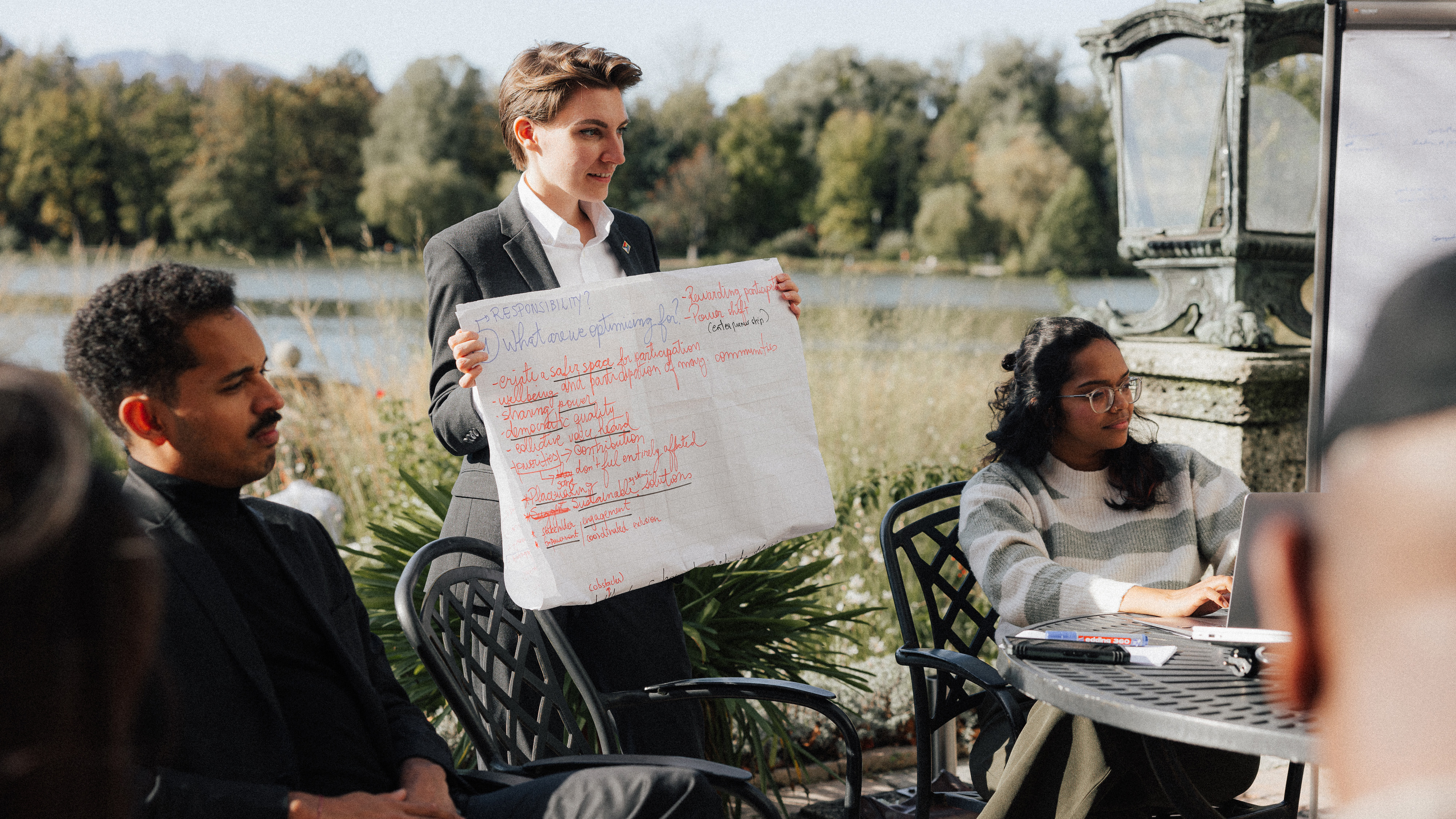
The authors of this article attended the Public Policy New Voices Europe session on "Toward Inclusive Democracy: Nurturing Diverse Leadership in Public Policy".
Whose voices truly shape the policies that govern our societies, and whose remain unheard?
Despite increasing commitments to diversity and inclusion, the policymaking process often excludes marginalized groups, perpetuating systemic inequities.1 How can governance systems evolve to reflect the diverse realities of all their constituents, particularly those traditionally sidelined?
Marginalization, described by Young (1990) as one of the "five faces of oppression", is the erosion of dignity and agency through systemic exclusion. Systematic exclusion or erosion of agency to selected persons or groups of people leads to a culture of privilege and lack of privilege, where the non-privileged are constantly scrambling for opportunities to survive the system designed against them, let alone graduate into the privileged bucket.
To offer a more critical lens into marginalization in policymaking, we employ the Academic Wheel of Privilege in this opinion piece. This framework highlights how systemic privilege amplifies certain voices while silencing others, mapping the intersecting factors—such as race, class, and gender—that determine access to power. Policymaking that ignores these realities not only risks entrenching inequality but also diminishes public trust and policy efficacy.
The current policy cycle exemplifies and exacerbates these issues. Without the systematic and intentional inclusion of diverse voices, the legitimacy of government is significantly undermined (Philipps, 1995), and social cohesion cannot be achieved (Mansbridge, 1999). Literature already suggests that true inclusion demands redistributing resources and dismantling institutional barriers (Fraser, 2008). We suggest that only dismantling of barriers, even if attempted, is insufficient and is redundant without creating genuine opportunities for engagement2 in every step of the policymaking process. Without such measures, policies risk being ineffective or, worse, harmful.
This thought piece reimagines the policy cycle to prioritize marginalized voices at every stage, from design to implementation. By integrating their perspectives, we are optimistic that an inclusive and transformative policy setting is at arm's reach.
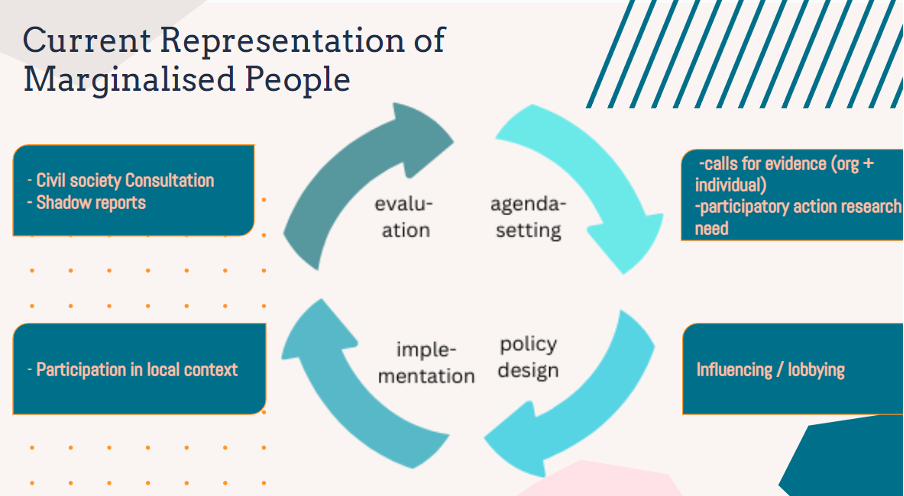
Policymaking cycles typically follow four main stages: agenda-setting, policy design, program implementation, and evaluation. Each stage plays a critical role in addressing societal needs, yet marginalized perspectives often remain excluded.
During agenda-setting, media, public opinion, and political pressures influence which issues gain attention. Marginalized voices are frequently overshadowed, as they lack the resources or networks to amplify their concerns.
Civil society organizations (CSOs) can bridge this gap by documenting lived experiences through testimonies, case studies, and petitions. These efforts help push issues onto political agendas by engaging local governments or gaining media attention. Such initiatives by CSOs are constrained by systemic barriers, including limited funding and a lack of access to decision-makers. Most policy systems currently treat civil society as an optional member submitting recommendations, in the best-case scenario.
Policy design involves developing solutions or strategies based on research and stakeholder input. Here, too, marginalized communities face significant hurdles. Governments and CSOs often fail to engage them meaningfully, leading to tokenistic consultations rather than substantive contributions. Without genuine engagement, policies risk being poorly informed or ineffective.
Marginalized groups often encounter obstacles during policy implementation. For instance, they may lack awareness of their rights or face systemic barriers that limit access to new services. Evaluation stages fare no better, as marginalized communities are rarely consulted on whether policies have met their needs (Rose, R., & Shevlin, M., 2024). This absence perpetuates distrust and weakens accountability.
Even in systems where evaluations are adopted frequently, such as the UK, the process consistently falls short of recommendations actually being adopted (Davies, P., 2012). Therefore, these evaluations occur as a mere tick-box exercise with no intent to actually make a difference. The avenue for such shortfalls being called out is also quite limited.
Despite these challenges, inclusive policymaking remains achievable. By addressing systemic obstacles and fostering genuine engagement, governments can ensure that marginalised voices are heard at every stage of the policy cycle.
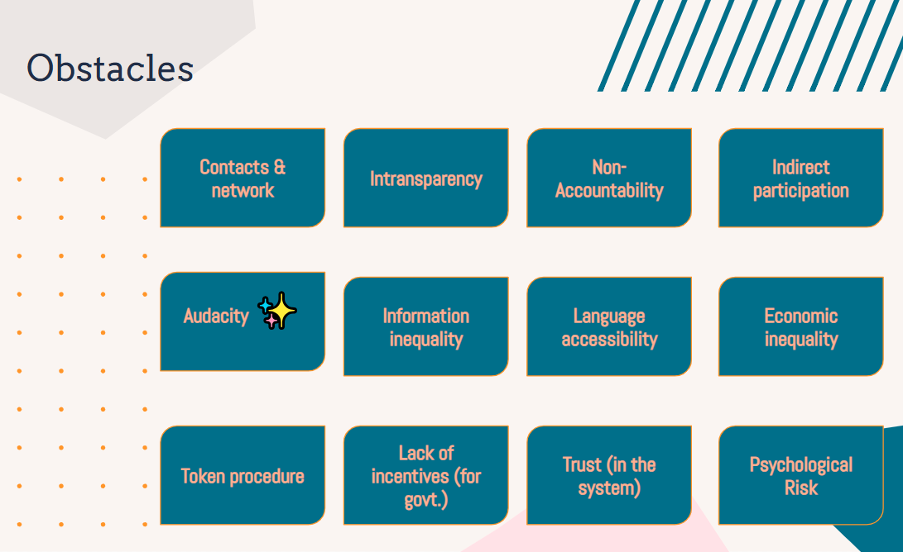
Effective stakeholder mapping is pivotal to ensuring marginalized voices are prioritized. Firstly, it is imperative to ensure that resources are allocated to identifying groups affected by or influencing policies to tailor interventions that address inequities (Reed et al.). However, traditional methods often prioritize high-power actors, overlooking marginalized communities.
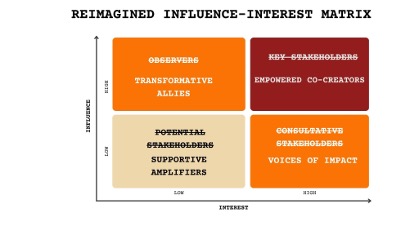
To address this, Arnstein's (1969) Ladder of Citizen Participation provides a framework for moving marginalized groups from tokenistic consultation to genuine decision-making. Incorporating the Academic Wheel of Privilege enhances this process by identifying structural inequities tied to race, class, gender, and ability (Fraser, 2008). A reimagined stakeholder matrix can prioritize equity, categorizing stakeholders as:
Empowered Co-Creators: High influence, high interest stakeholders, including empowered marginalized groups.
Voices of Impact: Low influence, high interest communities, whose lived experiences inform policies.
Transformative Allies: High-influence actors who support inclusive policymaking through advocacy.
Supportive Amplifiers: Peripheral actors engaged to validate and amplify inclusive outcomes.
An optimized policy cycle must uphold three core principles: systemic, genuine, and valued inclusion.
Integrating the principles and recommendations we have identified here can be the stepping stones to achieve a realistic and effective inclusive policy cycle that prioritizes marginalized communities, ensuring equitable and transformative governance at every stage of the process.
Solutions must be systemic, genuine, and collaboratively crafted, addressing structural inequities rather than perpetuating them. As societies globally grow more and more increasingly diverse, inclusive policymaking is no longer optional—it is essential.
The time to act is now: let us create policies with marginalized communities, not merely for them.
1Office of the United Nations High Commissioner for Human Rights. (2021, October 27). Available at: https://www.ohchr.org/en/press-releases/2021/10/minorities-being-left-behind-growing-inequality-discrimination-and
2Sen's (1999) capabilities approach underscores the need to empower marginalized groups by creating genuine opportunities for engagement.