
Session report highlights takeaways from Salzburg Global's Africa Forum on designing an African-shaped global future
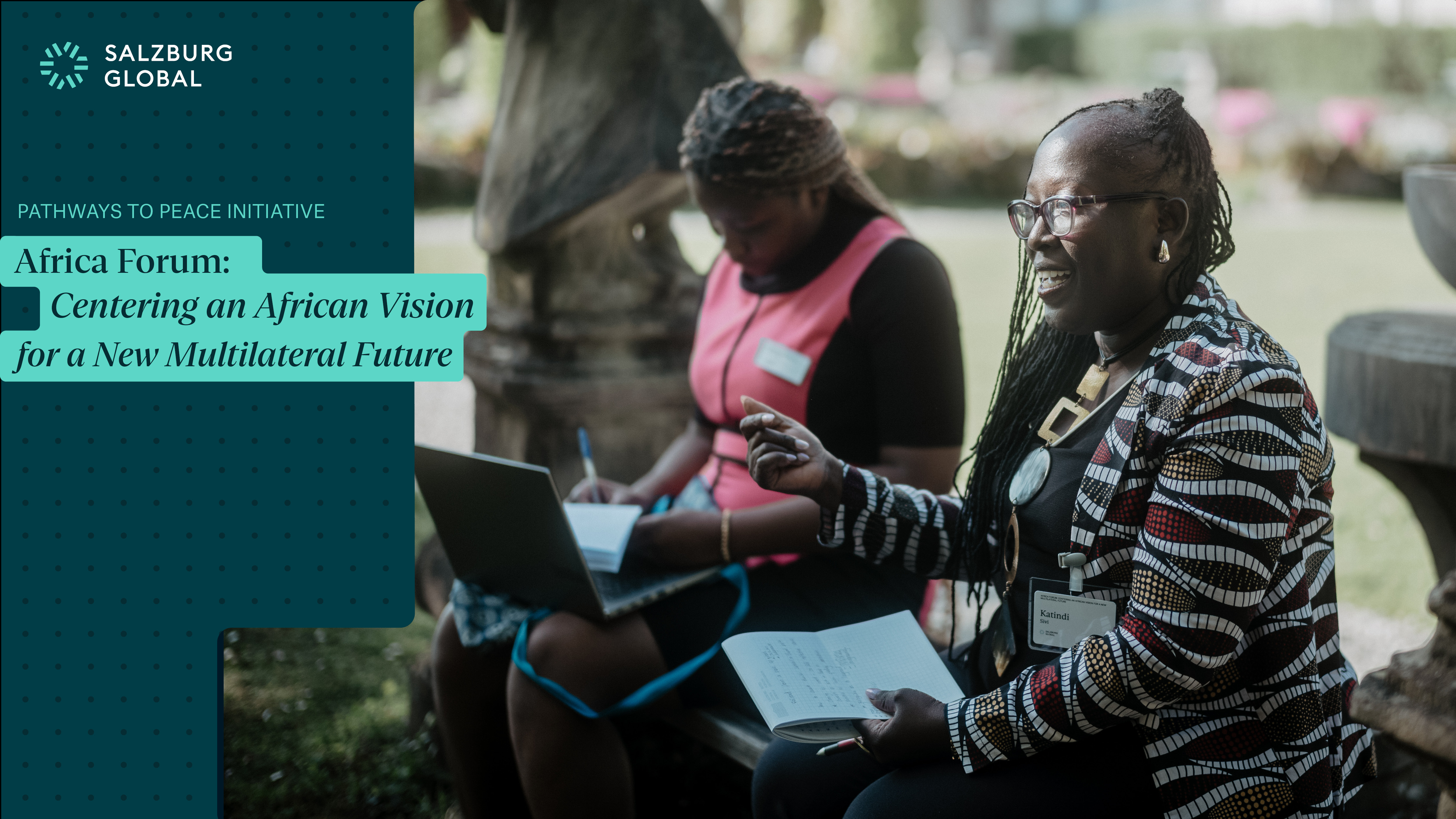 Photo Credit: Richard Schabetsberger
In April 2025, over 40 Salzburg Global Fellows - comprising an intergenerational group of citizens from across Africa, diaspora members, and international experts engaged in African affairs - gathered at Schloss Leopoldskron for the “Africa Forum: Centering an African Vision for a New Multilateral Future.”
This session was held under our Pathways to Peace Initiative, which addresses urgent geopolitical challenges by providing a forum for open and critical dialogue on key issues affecting political, strategic, economic, and cultural relationships.
It also served as a cornerstone of our annual spotlight on “Centering Africa,” which places a special focus on the African continent and its potential to have a transformative influence on the rest of this century. As demographic trends across much of the world project a future of older and less productive economies, the African continent stands out for its growing youth population, its dynamism and innovation, and its increasingly central role in addressing numerous global challenges, including economic advancement and poverty alleviation, youth opportunity and employment, technology and cultural innovation, and climate change and conservation. Throughout our sessions and special events in 2025, we have sought to highlight the central role that the African continent—in all its diversity, complexity, and promise— is playing in shaping the 21st century.
Our 2025 spotlight on Africa did not emerge in isolation, nor is it confined to a single session or year. On the contrary, it reflects a growing global imperative to recognize and engage with African voices in reimagining a more just and inclusive multilateral system. This is a moment of intentional reflection and renewed commitment for Salzburg Global – and for the world – as Africa assumes an increasingly central role in addressing global challenges.
The Africa Forum marked a profound moment of reflection and imagination. Through frank conversation and collective creativity, Fellows articulated a shared commitment to shaping a self-determined future for the continent - grounded in African agency, leadership, and vision. The session and its outcomes aim to catalyze sustained African-led efforts to redefine Africa’s role in, and vision for, a changing global order. The key takeaways from the Africa Forum reflect Fellows' calls to move from rhetoric to action, and from extraction to partnership, as Africa continues to shape global narratives and futures.
Below are key takeaways from the Africa Forum. A more detailed account is available in the full report here.
Africa is at a critical crossroads after enduring centuries of colonial domination and resource extraction. Although African countries began regaining independence in the mid-20th century, the current international order was already established, meaning African nations had no say in setting the status quo. Further, political instability through military coups and authoritarian regimes often hindered democratic development.
Youth movements, civil society, and other forms of citizen action are increasingly holding power to account, yet governments often fall short of delivering political and economic outcomes their citizens demand.
This tension reflects a broader reckoning with Africa’s identity, agency, and development trajectory amid both internal contradictions and the persistent marginalization within multilateral systems that historically treated Africa “as a project, not a partner.”
Calls for multilateralism “with Africa at the center” emphasize self-determined initiatives such as creating an African debt sustainability institution and a continent-wide credit rating agency. Africa’s demographic and ecological capital present immense opportunities for global leadership – if its leadership can be reimagined to prioritize the richness of Africa and all it holds in its people, its land, and its resources.
Africa’s young population is actively shaping its future – 60% of the continent is under 25 years old.
Young Africans are rejecting outdated norms and regimes, and are mobilizing innovative solutions to claim their place in the 21st century. Youth movements have been at the forefront of demands for democratic reform, social justice, and accountability, demonstrated by significant campaigns like South Africa’s #FeesMustFall, Nigeria’s #EndSARS, and Kenya’s #RejectFinanceBill.
These movements use social media, art, and music to organize and raise awareness, often facing state repression but persisting nonetheless. There is tension between generational demands for new leadership and older institutional frameworks reluctant to yield power, underscoring the need for inclusive intergenerational collaboration and genuine empowerment of youth voices. The Africa Forum recognized that empowering youth is critical to building the Africa that the continent, and the world, need.
Despite their historical role as community pillars, African women face systemic exclusion exacerbated by patriarchal structures, climate crises, and economic inequities. Over 60% of Africa’s 450 million unbanked people are women, illustrating economic disempowerment and lost opportunities for inclusive growth.
Systemic issues, often rooted in patriarchal status quos and inequality cycles, mean that girls’ education is compromised by climate-related burdens and domestic responsibilities, increasing gender-based violence risks, and reinforcing cycles of inequality.
But an inspiring vision is rising: women across the continent and diaspora are leading governance, peacebuilding, and innovation. Feminist leadership models that are collaborative and decolonial offer pathways to transformation.
Young African women, particularly, are reclaiming their voice and influence through activism, education, and grassroots organizing. Centering women is vital to unlocking Africa’s full potential. Ultimately, African futures must reimagine power to prioritize care, community, and sustainability.
Africa needs partnerships that respect African agency while recognizing the complex realities of global power dynamics. Moving beyond legacies of extraction and dependency requires a shift toward cooperation grounded in mutual interest, where African-led priorities are taken seriously, and contributions from all sides are valued. Genuine partnership may not always mean perfect equality, but it does require transparency, shared goals, and a commitment to avoiding exploitative or neo-colonial practices. Partnerships must embed African ownership, decision-making authority, and equitable resource sharing.
Allies should engage not merely to amplify African voices, but to co-create solutions under African leadership that serve both African aspirations and broader global interests. Examples of this include the Lobito Corridor project, a partnership connecting the port of Lobito in Angola to Zambia and the Democratic Republic of Congo (DRC) via railway, supported by the U.S., the EU, and other partners, and South Africa’s Just Energy Transition Partnership (JETP), an $8.5 billion climate finance deal between South Africa and a group of developed nations (including the U.S., UK, and EU) which aims to support the coal-dependent country’s transition from coal to renewable energy.
Allyship requires honest reflection on both external influences and internal governance models. African governance must prioritize effectiveness, cultural relevance, and human dignity rather than mimic foreign institutional templates. Current systems often suffer from “accidental leadership” and elite capture, which erode trust and perpetuate inequality. Leadership should be redefined as accountable stewardship.
Multilateral institutions like the African Union and regional bodies must evolve from symbolic platforms to transformative agents with real influence in policy making, conflict mediation, and democracy defense.
Economic sovereignty is essential, and a shift from commodity dependence to value-creating, resilient economies driven by domestic savings and diaspora investment is crucial. Protecting Africa’s rich natural resources, biodiversity, and ecosystems must be central to sustainable development
Transforming Africa’s future requires confronting colonial legacies and systemic inequities by reclaiming narratives, power, and self-determined governance. Reframing Africa’s global position begins with honest conversations on the continent, building spaces for African-led dialogue and design.
The Africa Forum emphasized moving from the adaptation of imported models to trusting African capacity to lead transformation. This includes cartographic justice through accurate map representations, recognizing Africa's true size and importance, and promoting map literacy in schools and public institutions.
African institutions must embed pan-African financial architectures, synchronize policies across regional bodies, and implement Agenda 2063 with clear metrics to measure progress. Governments need to invest in youth and women as strategic assets and decentralize governance, while civil society and youth must continue mobilizing.
Africa’s biggest challenge is bridging the gap between vision and implementation. The future must be African-shaped – youth-led, gender-inclusive, and aligned with the planet’s needs. Salzburg Global’s Africa Forum concluded with a shared commitment to ongoing dialogue, empowerment, and accountable leadership, aiming to build a continent where Africans determine their own destiny, revive the multilateral order, and no longer ask what can be extracted – but what can be created.
View the publication on ISSUU:
This program is part of our Annual Spotlight: “Centering Africa." Across our sessions and events in 2025, Salzburg Global is highlighting the central role that the African continent will play in global development now and in the next decades. As demographic trends across much of the world project a future of older and less productive economies, the African continent stands out for its growing youth population, dynamism and innovation. In reimagining an international system that better responds to the needs of the 21st century, it is our hope that Salzburg Global can play a small but meaningful role in centering African ideas, innovations, and perspectives in global forums like ours.